Trụ Sở


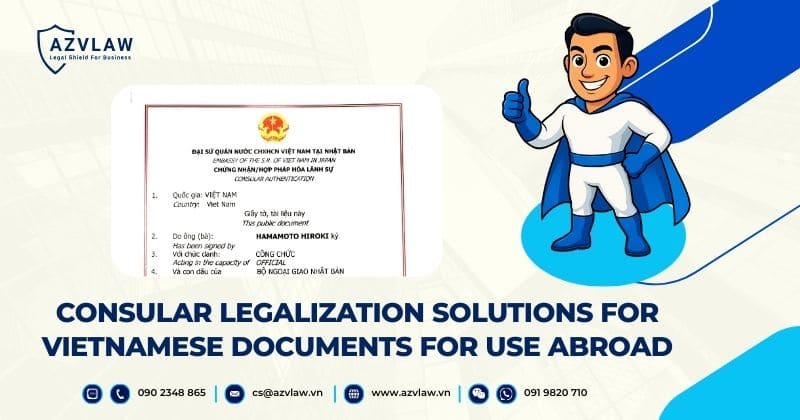
When individuals, businesses, or organizations in Vietnam need to use documents for administrative procedures, studies, employment, marriage, immigration, investment, or business activities abroad—such as birth certificates, diplomas, marriage certificates, criminal record checks, household registration books, business licenses, contracts, or powers of attorney—simply translating these documents into a foreign language isn’t enough. For these documents to be legally recognized and accepted in the destination country, they must undergo consular legalization in Vietnam.
Consular legalization of Vietnamese documents is the process of authenticating the legality of papers issued by competent authorities in Vietnam, so that these documents can be lawfully used abroad. This is a mandatory procedure for most applications for visas, work permits, marriage registration, residency, or studying abroad, especially for countries that are not signatories to the Hague Apostille Convention.
However, in practice, not everyone fully understands the legalization process and its specific requirements. Any error at any stage—such as missing notarization, incorrect translation, invalid documents, or improper authentication—can lead to the foreign consular office rejecting the application. To help clients avoid such unnecessary complications, AZVLAW provides comprehensive consular legalization services for Vietnamese documents for use abroad – ensuring a fast, accurate, end-to-end, and time-saving process.
1. Why Is Consular Legalization Necessary?
Consular legalization is a critical step because it confirms the authenticity of the signature, seal, or stamp on a document. When a document is legalized, it essentially makes it valid for use in a foreign country, bridging the gap between Vietnamese legal standards and those of the destination country.
This process is particularly vital for countries not part of the Hague Apostille Convention, where a simple apostille is not sufficient. Without it, your Vietnamese documents may not be accepted by foreign governments, educational institutions, or legal entities.
2. When Do You Need Consular Legalization for Vietnamese Documents?
When using Vietnamese documents abroad—whether for work, study, marriage, or immigration—many foreign authorities require those documents to be legally recognized in their country.
This is where consular legalization comes in. It is the official process of authenticating Vietnamese-issued documents so they can be accepted overseas.
You will typically need to have your documents consular legalized in Vietnam for the following common scenarios:
- Study Abroad Applications: Requires legalization of diplomas, academic transcripts, and school records.
- Applying for Work Visas Abroad: Needs criminal record checks, employment confirmation letters, diplomas, and labor contracts.
- Marriage Procedures with Foreigners: Requires certificates of single status, birth certificates, and marriage certificates (if already married).
- Immigration or Family Reunification: Necessary for birth certificates, personal identification documents, household registration books, marriage certificates, adoption papers, etc.
- Business Cooperation or Investment Abroad: Essential for business licenses, company charters, financial reports, contracts, and powers of attorney.
3. The Consular Legalization Process for Vietnamese Documents
Legalizing Vietnamese documents for use abroad involves a multi-step process to ensure they are officially recognized by foreign authorities. From notarization and certification by Vietnam’s Ministry of Foreign Affairs to final authentication at the foreign embassy or consulate, each step must be completed accurately to avoid delays or rejection.
3.1 Conditions for a Document to Be Eligible for Consular Legalization
To be eligible for consular legalization (and subsequently used in a foreign country), a document generally needs to satisfy these conditions:
- Legally Issued: The document must have been legitimately issued by a competent authority in Vietnam (e.g., a Vietnamese Ministry, court, educational institution, hospital, public administrative body, or other legitimate organization recognized by the Vietnamese state).
- No Prohibitions: The document must not fall into a category prohibited from use in Vietnam or be on the list of documents rejected for legalization by the Vietnamese Ministry of Foreign Affairs.
- Prior Authentication (if applicable): If the document is an original and not a notarized copy, it may need to be authenticated by the issuing Vietnamese authority before consular legalization.
3.2 The Standard Consular Legalization Process for Vietnamese Documents
At AZVLAW, we typically guide our clients through a four-step process for consular legalization of Vietnamese documents intended for use abroad:
Step 1: Document Preparation and Notarization.
You provide the original or copies of the documents requiring legalization. These documents will then be translated into the required foreign language, and the translations will be notarized.
Note: If the document has already been notarized or issued as a certified copy by a competent authority, this notarization step might be bypassed.
Step 2: Certification by the Vietnamese Ministry of Foreign Affairs.
After notarization, the documents are submitted to the Consular Department – Ministry of Foreign Affairs of Vietnam, or the Department of Foreign Affairs in the provinces, to obtain the legalization stamp. This step confirms that the document was legitimately issued in Vietnam.
Step 3: Legalization at the Foreign Embassy/Consulate in Vietnam.
Once certified by the Vietnamese Ministry of Foreign Affairs, the documents are then taken to the Embassy or Consulate of the destination country in Vietnam. Here, a legalization stamp or sticker is affixed, confirming that the document meets the requirements for legal use in their country.
Note: Each country has different requirements regarding language, forms, document validity periods, etc. It’s crucial to thoroughly check the specific guidelines from the destination country’s consulate to avoid having to restart the process.
Step 4: Notarized Translation (if required by the destination country after legalization).
Depending on the specific requirements of the destination country for submitting documents, AZVLAW will guide you on how to submit your dossier to the foreign authority. Sometimes, an additional notarized translation might be required after the consular legalization, or a translation into a specific language might be needed at this final stage for the destination country’s review.
4. AZVLAW’s Consular Legalization Services
In practice, despite its fundamental importance, the process of consular legalization for Vietnamese documents can be intricate and fraught with potential errors. A single mistake—such as missing notarization, an incorrect translation, invalid underlying documents, or improper authentication—can lead to the foreign consular office refusing to accept your application, causing significant delays and frustration.
With years of practical experience in immigration and document authentication, AZVLAW provides comprehensive consulting and end-to-end support for consular legalization procedures. Our services are tailored to each client’s specific needs, ensuring a fast, accurate, and transparent process that saves you time and effort. We don’t just guide you; we ensure every step is handled correctly.
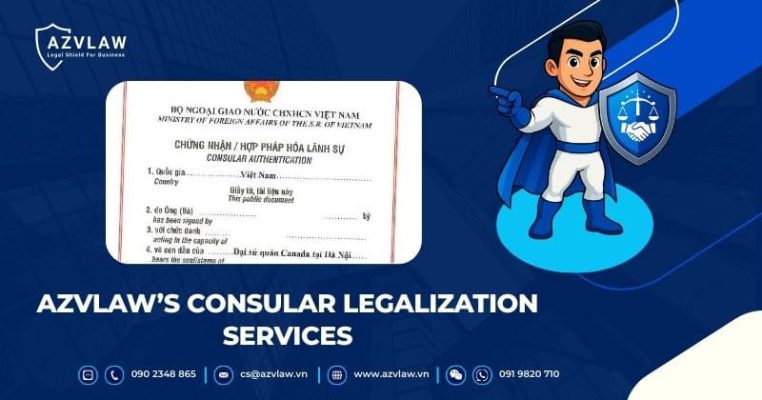
AZVLAW supports receiving dossiers online and via express delivery nationwide, ensuring accessibility for clients across Vietnam. We also assist with all necessary supporting procedures, such as notarized translations and any required certifications, to guarantee accuracy and compliance.
How AZVLAW Ensures Your Success?
- Expert Guidance: We provide detailed advice on the specific requirements for your destination country, ensuring all documents meet the necessary standards.
- Error Prevention: Our team meticulously reviews all your documents for accuracy, completeness, and proper authentication before submission, minimizing the risk of rejection.
- Streamlined Process: We manage the entire four-step process on your behalf, liaising directly with Vietnamese authorities (Ministry of Foreign Affairs) and relevant foreign Embassies/Consulates in Vietnam.
- Comprehensive Support: From initial document preparation and translation to final submission, we handle all the complexities, including any necessary notarizations or certifications.
- Time & Cost Efficiency: Our expertise and efficient procedures help you avoid costly delays and re-submissions, ensuring your documents are legalized correctly and promptly.
5. Frequently Asked Questions (FAQ)
Question 1: Which documents cannot be consular legalized?
Documents that have been altered, erased, contain spelling errors, or were not issued by a competent authority will be rejected.
Question 2: How long does the legalization process take?
On average, it takes approximately 5–7 working days, depending on the volume of documents and specific requirements.
Question 3: Can I submit documents from other provinces?
Yes. AZVLAW supports receiving dossiers online and via express delivery nationwide, providing convenience for clients across the country.
Contact Information for Service Consultation
- Hotline: 090.2348.865
- Email: cs@azvlaw.vn
- Website: www.azvlaw.vn