Trụ Sở


Vietnam Tourist Visa: Your Comprehensive Guide for a Smooth Journey
For countless international travelers, Vietnam stands out as an enticing destination, offering vibrant culture, stunning landscapes, and rich history. To experience all that this beautiful country has to offer, securing a Vietnam tourist visa is a mandatory requirement for most foreign visitors. While the process is designed to be accessible, understanding the specific visa types, eligibility criteria, and detailed application procedures can still be confusing. At AZVLAW, we specialize in simplifying these complexities, providing clear guidance and efficient services to ensure your Vietnam tourist visa application is smooth, compliant, and allows you to focus on planning your unforgettable journey.
1. Vietnam Tourist Visa
When you envision exploring the ancient streets of Hanoi, cruising through the mystical Halong Bay, or savoring the bustling street food in Ho Chi Minh City, the very first thing you need to consider is your Vietnam tourist visa.
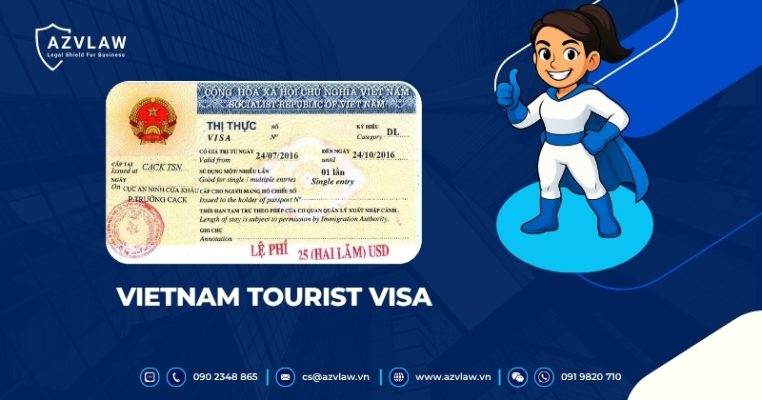
This is the most common type of visa, specifically designed for those wishing to enter Vietnam for sightseeing, relaxation, and cultural exploration. Possessing a valid visa is the crucial first step that unlocks your unforgettable experiences here.
2. Vietnam Visa Exemption: Do You Qualify?
You might be asking yourself, “Is there a way to enter Vietnam without needing a visa at all?” Fortunately, the answer is YES! Vietnam has a visa exemption policy for citizens of certain countries. This is often the simplest and most convenient option if your nationality falls within this fortunate list.
However, visa exemptions come with limitations—such as restricted duration of stay and specific entry conditions. It’s important to verify whether your country is currently eligible and understand the rules that apply. If you’re unsure or your situation is more complex, AZVLAW can help you assess your options and ensure you enter Vietnam legally and confidently.
3. Who is Eligible for Visa-Free Entry to Vietnam?
The visa exemption policy allows you to enter and stay in Vietnam for a specific period without the need for a formal visa application process. Here are the specific nationalities and their allowed durations:
- ASEAN Countries: If you are a citizen of a Southeast Asian nation, you are typically granted visa exemption for 14 to 30 days.
- Chile and Panama: Citizens of these two countries enjoy a generous visa exemption period of up to 90 days.
Selected European and Northeast Asian Countries: Notably, citizens from Belarus, Denmark, Finland, France, Germany, Italy, Japan, Norway, Russia, South Korea, Spain, Sweden, and the United Kingdom (British citizens only) are granted a 45-day visa exemption. Good news on this front: under the latest immigration law, the previous requirement for a minimum 30-day gap between two visa-free entries has been removed. This offers significant flexibility if your travels involve frequent entries and exits from Vietnam.
3.1 Important Conditions for Visa-Free Travel
Even if you qualify for a visa exemption, there are still a few crucial conditions to keep in mind to ensure your trip remains hassle-free:
- Valid Passport: Your passport must be valid for at least 6 months from your intended date of entry into Vietnam. Please, double-check this carefully!
- Return or Onward Ticket: You will need to provide proof of your departure from Vietnam (a round-trip flight ticket or a ticket continuing to a third country) within your allowed visa-free stay period.
- Always Check for Updates: Visa policies can change. Therefore, we always recommend checking the latest regulations directly with the Vietnamese Embassy or Consulate in your country before you travel.
How to Get a Vietnam Visa?
If your nationality isn’t covered by the visa exemption policy, or if you wish to stay longer than the exempted period, you will need to apply for a visa. Don’t worry, there are several ways to do this, and we’ll guide you through each step.
3.2 Apply for A Vietnam visa at the Embassy
This is the traditional method, familiar to many. You can apply for a tourist visa directly at the Vietnamese Embassy or Consulate in your country of residence. This method is often chosen when you seek a longer-term visa than what an E-visa offers, or in certain specific circumstances.
3.3 The Traditional Application Method
Step 1: Meticulous Document Preparation.
- Visa Application Form: You can usually download this from the Embassy’s website or obtain it directly there. Please fill out all the information completely and accurately.
- Original Passport: It must be valid for at least 6 months and have at least 2 blank pages for the visa stamp.
- Passport-sized Photos: Prepare two recent photos (4x6cm or 3x4cm), with a white background.
- Return Flight Ticket / Travel Itinerary: While not always strictly mandatory for a standard tourist visa, having a clear travel plan can strengthen your application.
- Invitation Letter (if any): If you have acquaintances or partners in Vietnam inviting you, an invitation letter can be a useful supplementary document.
Step 2: Submit Your Application and Pay the Fees.
You will submit your application in person at the Embassy or Consulate.
Pay the visa fees. Please note that these fees can vary depending on the specific Embassy or Consulate and the type of visa you are applying for.
Step 3: Collect Your Visa.
The processing time is typically 3-5 working days, though it can sometimes take longer.
Once approved, your visa will be directly stamped into your passport.
3.4 Apply for a Vietnam Visa on Arrival (VOA)
In the past, Visa On Arrival (VOA) was quite a popular option for international visitors to Vietnam. However, with the introduction and widespread adoption of the E-visa, VOA for general tourist purposes has largely been superseded.
3.5 Is Vietnam Visa On Arrival Still an Option for Tourists?
Essentially, if you are a regular tourist, the E-visa is now the recommended and significantly more convenient option compared to VOA. The reason is that an E-visa allows you to complete all formalities online before you fly, avoiding the need to queue and process paperwork at the airport upon arrival.
If you still need to use VOA for a specific reason, the most critical point is that you must obtain an official Visa Approval Letter issued by the Vietnam Immigration Department BEFORE YOU FLY. You will need to contact a visa service company in Vietnam (like AZVLAW!) to secure this approval letter. Then, upon arrival at one of Vietnam’s international airports, you will present this approval letter, your passport, photos, and pay a stamping fee to receive your visa.
AZVLAW’s Recommendation:
We, at AZVLAW, consistently advise our clients to prioritize the E-visa for tourist purposes. An E-visa offers transparency, convenience, and helps you avoid unnecessary hassles at the airport or additional costs from third-party approval letters.
3.6 Apply for a Vietnam E-visa
This is the “star” among current tourist visa options, favored by most travelers for its convenience and speed. The Electronic Visa (E-visa) allows you to apply for and receive your visa entirely online.
3.7 The Most Convenient Online Application
Why is the E-visa so popular?
Global Reach: Currently, citizens of ALL countries and territories can apply for an E-visa.
Flexible Validity: An E-visa is valid for up to 90 days, and you can choose either single or multiple entry.
Clear Costs: The fixed fee is 25 USD for a single-entry e-visa and 50 USD for a multiple-entry e-visa (please note, this fee is non-refundable if the application is denied).
Designated Ports of Entry: You must enter and exit through specific international checkpoints designated by the Vietnamese Government (a detailed list is available on the official E-visa portal).
3.8 Step-by-Step E-visa Application Process
This process is conducted entirely online, making it quite straightforward and intuitive:
Step 1: Prepare Photos and Information.
Upload your portrait photo (4x6cm, white background, no hat, no glasses, formal attire, looking straight ahead, JPG/JPEG file under 2MB).
Upload a photo of your passport data page. The system will automatically display personal information from your passport; you will need to review and update it if there are any errors.
Step 2: Complete the Online Application Form.
Fill in all mandatory information (marked with an asterisk *) and any other optional fields (if applicable).
Please review all information very carefully before confirming and proceeding.
Step 3: Make Payment and Get Your Registration Code.
Pay the E-visa fee via the secure electronic payment gateway.
After successful payment, you will receive a registration code. Please keep this code safe, as it is your “key” to checking the status of your application later.
Step 4: Check Results and Print Your E-visa.
After approximately 3 working days (this time can vary depending on application volume and peak seasons), revisit the E-visa portal, enter your registration code, email, and date of birth to check the results.
If approved, you will print out your E-visa. This is a crucial document you must present upon entry and exit from Vietnam.
3.9 Crucial E-visa Tips from AZVLAW
To avoid any unnecessary complications:
Submit your application at least 2 weeks before your intended entry date. Processing times can sometimes be longer than expected, especially during peak seasons.
Ensure your passport is valid for at least 6 months from your planned entry date and has at least 2 blank pages.
The purpose of your entry must strictly match the visa type you applied for (tourism). Do not attempt to use a tourist visa for work purposes; this will lead to serious legal issues.
4. Visa Extension
So, what if you “fall in love” with Vietnam and wish to extend your stay beyond your current tourist visa’s validity? The good news is, YES, you can certainly consider extending your Vietnam tourist visa.
Can You Extend Your Vietnam Tourist Visa?
Extending your tourist visa is an option that allows you to prolong your legal stay in Vietnam. Typically, such extensions might grant you an additional 15 to 30 days, depending on current regulations and your specific circumstances.
However, it’s important to note that the regulations surrounding visa extensions can be quite complex and are subject to frequent changes. The required documentation and conditions might differ based on your initial visa type and the time you submit your application.
AZVLAW’s Advice: If you are considering a visa extension, we strongly recommend seeking professional advice as early as possible. Do not wait until the last minute, as the process can take time and requires thorough preparation. We can help you understand the current conditions and guide you through completing the necessary forms to maximize your chances of a successful outcome.
5. Transit Visa
Are you planning a connecting flight through Vietnam and wondering if you need a transit visa? This is a very common question!
Do You Need a Transit Visa for Vietnam?
The answer largely depends on several factors:
- When a transit visa is NOT needed:
- If you are only transiting directly within the international airport area (without passing through immigration, not collecting luggage, not needing to change airports) and your layover is short.
- If you are a citizen of a country with a visa exemption policy with Vietnam and your transit time falls within the visa-free limit.
- When a transit visa MIGHT be needed:
- If you have a long layover and wish to leave the airport’s transit area to sightsee or stay in a hotel.
- If you have to change airports (e.g., landing at one airport and flying out from another in the same city).
- If your flight requires you to collect luggage and check-in again, which means you will have to pass through immigration.
AZVLAW’s Advice: To avoid any unnecessary complications, especially if you have a complex connecting flight schedule or intend to leave the airport during your layover, always check with your airline and the Vietnamese Embassy/Consulate in your country before you fly. They will provide the most accurate information based on your nationality and specific itinerary.
6. General Passport Requirements for Entry to Vietnam
Before planning your trip to Vietnam, it’s essential to ensure your passport meets the country’s entry requirements. Regardless of visa type—whether it’s a tourist visa, business visa, or visa exemption—Vietnamese immigration authorities have clear rules regarding passport validity and condition.
Overlooking these basic requirements can lead to denied boarding or entry at the border. In this section, we’ll outline the general passport rules you must follow to enter Vietnam smoothly and legally.
Regardless of how you enter Vietnam – be it through visa exemption, E-visa, or a traditional visa – your passport is always the most critical “key.” Therefore, please ensure it meets the following essential conditions:
- Essential Passport Conditions for Your Vietnam Trip
- Validity Period: Your passport must be valid for at least 6 months from your intended date of entry into Vietnam. This is a mandatory regulation!
- Blank Pages: Your passport needs to have at least 2 blank pages for visa stamps or entry/exit stamps.
- Passport Condition: Please ensure your passport is not damaged, torn, or shows any signs that it is not fully intact. There have been cases where travelers were denied entry simply because their passport was in poor condition. Double-check it thoroughly before you fly!
7. Why Choose AZVLAW for Your Vietnam Visa Needs?
Dear Valued Client,
As you can see, even a seemingly simple tourist visa can involve specific details that require careful attention. And when facing more complex issues like visa extensions or special entry cases, a feeling of anxiety is completely understandable. This is precisely where AZVLAW steps in to become your trusted partner.
At AZVLAW, we are more than just legal experts; we are experienced companions who listen and empathize with your concerns. Our team of seasoned lawyers and specialists possesses in-depth knowledge and practical experience in Vietnamese immigration law. We are committed to making this process a smooth, efficient, and reassuring experience for you.
Navigate Your Vietnam Trip with AZVLAW’s Expert Guidance
We will help you:
- Address all your queries: From the smallest questions to complex scenarios, we will provide clear and accurate answers.
- Guide your documentation: You will receive a detailed, personalized document checklist for your specific case, ensuring no crucial paperwork is overlooked.
- Optimize your process: We will guide you step-by-step, from preparation to submission, helping you save time and effort.
- Handle special cases: If you have unique entry requirements or need assistance beyond the scope of a standard tourist visa, we have the expertise to advise and support you.
For a confidential consultation regarding your Vietnam tourist visa application or any other essential immigration matters for your travels to Ho Chi Minh City or anywhere in Vietnam, do not hesitate to contact AZVLAW today via HOTLINE: 090.2348.865. We are here to help you begin your adventure with unwavering confidence.