Trụ Sở


How To Set Up a Representative Office In Vietnam
Home Company services Representative office in Vietnam
For foreign enterprises considering a commercial presence in Vietnam, the most common and often comprehensive approach is to establish a foreign-owned company. However, a representative office in Vietnam offers a highly strategic and suitable alternative for many, serving as an initial, lower-cost entry point into this dynamic market.
1. Strategic Entry: Why a Representative Office Might Be Your First Step
For many foreign businesses looking to enter the Vietnamese market, setting up a representative office is a smart and strategic first move. While it does not permit direct commercial activities, a representative office allows you to establish a legal presence, conduct market research, build local relationships, and promote your brand—all without the complexities of full company formation.
Setting up a Representative Office in Vietnam is widely recognized as an effective initial market entry mechanism for foreign investors. It allows your foreign entity to:
- Establish a Legal Presence: Secure a formal, legitimate foothold within Vietnam’s legal and business environment.
- Employ Staff: Legally hire both local Vietnamese employees and expatriates (subject to work permit requirements) to manage operations and conduct activities.
- Gain Market Understanding: Develop a deeper, firsthand comprehension of the local market, including consumer trends, competitor landscapes, and distribution channels.
- Build Relationships: Cultivate essential relationships with local partners, suppliers, and government agencies.
- Strategic Foundation: Serve as a preparatory phase, allowing your company to refine its strategies and gather intelligence before committing to a larger, potentially profit-generating investment like a full foreign-owned company.
2. Navigating Operational Boundaries: What Your RO Can (and Cannot) Do
It is critically important to understand that Representative Offices in Vietnam operate within a deliberately limited scope. Vietnamese authorities strictly define these boundaries to ensure that all direct commercial activities and revenue generation occur through taxable entities, such as companies.
Under Vietnamese law, a Representative Office (RO) is specifically permitted to:
- Undertake Market Research: Conduct comprehensive studies and investigations into market conditions, opportunities, and industry dynamics.
- Act as a Liaison Office: Serve as a communication bridge, facilitating interaction and coordination between your parent company abroad and its partners, clients, or internal teams in Vietnam.
- Promote Business Investment Opportunities: Engage in activities that introduce and promote the parent company’s brand, products, or services, aiming to foster future business opportunities in Vietnam.
- Crucial Limitation: It is vital to note that a significant change implemented in March 2016 removed the ability for Vietnam ROs to “monitor and promote the performance of contracts signed with Vietnamese partners or those relating to the Vietnamese market on behalf of its foreign parent.” The clear implication of this is that ROs are explicitly prohibited from engaging in commercial activities or directly supporting their parent entity’s commercial, profit-generating activities within Vietnam. This means an RO cannot directly sign sales contracts, issue invoices, or generate revenue.
Despite these commercial limitations, an RO retains the fundamental rights to employ staff to execute its permissible plans (including foreign individuals, who must obtain appropriate work permits) and to open bank accounts in Vietnam for operational expenses.
3. Laying the Foundation: Key Requirements for Your Parent Company and Chief Representative
Establishing a representative office in Vietnam requires not only local compliance but also proper documentation from the foreign parent company and the appointed chief representative.
Vietnamese law outlines specific conditions—such as the operational duration of the parent company, legal standing, and the qualifications of the chief representative—that must be met to ensure a successful registration
To successfully establish an RO in Vietnam, both your foreign parent company and the designated Chief Representative must meet specific eligibility criteria:
Parent Company Requirements:
- Operational History: Your foreign parent company must demonstrate a minimum of one year of continuous operation from its date of establishment or registration. This ensures a track record of stability.
- Valid Registration: The Business Registration Certificate (or an equivalent legal document) of your parent company must remain valid for at least one year from the date you submit the RO application.
Representative Office Requirements:
- Designated Chief Representative: A qualified individual must be appointed as the Chief Representative. This person will be the legal head of the RO in Vietnam.
- Legitimate Office Address: The RO must secure a verifiable physical office address in Vietnam, which will be officially registered with the authorities.
Critical Restrictions for the Chief Representative:
To maintain clear legal distinctions and prevent conflicts of interest, the Chief Representative of an RO cannot concurrently hold any of the following positions:
- Head of a branch of the same foreign trader (your parent company).
- Head of a branch of another foreign trader.
- Legal Representative of the same foreign trader or any other foreign entity.
- Legal Representative of a business organization established under Vietnamese law.
4. The Registration Journey: Three Key Steps to Establish Your RO
Setting up a Representative Office (RO) in Vietnam involves a structured legal process that ensures your business operates within local regulations. From preparing the right documents to obtaining official licenses, each step must be handled carefully to avoid delays or rejections.
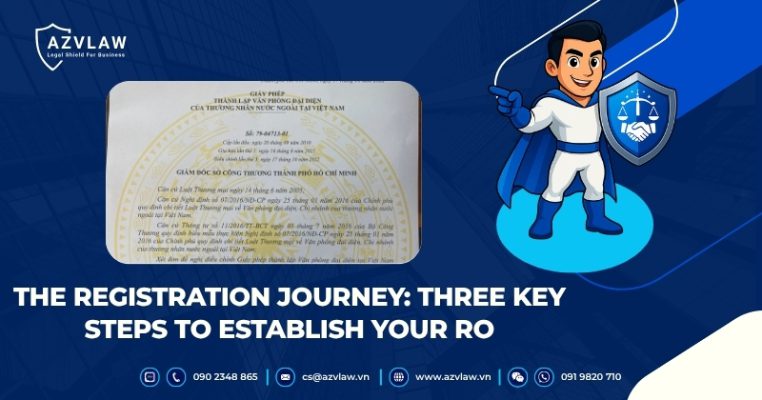
The process of establishing a Representative Office in Vietnam typically follows a structured, three-step approach. While timelines can vary, understanding each phase is crucial for efficient execution:
Step 1: Document Preparation (Estimated: Up to three weeks)
This initial phase is foundational. Accurate and complete documentation is key to avoiding delays. Essential documents include:
- Lease Agreement: A valid lease (or pre-lease) agreement for the specific office space where your RO will be registered.
- Chief Representative’s Legal Identification: A legally attested copy of the Chief Representative’s passport (for foreign nationals) or a notarized ID card (for Vietnamese citizens).
- Parent Company Documentation: Certified and legalized documents from your foreign parent company, including its Certificate of Incorporation/Business Registration Certificate and recent audited financial statements. These documents often require consular legalization in your home country and notarized Vietnamese translations.
Step 2: Registration of Representative Office Certificate (Estimated: Up to four weeks)
Once your comprehensive application dossier is meticulously prepared, it is officially submitted to the relevant licensing authority.
- Submission Authority: Applications are typically submitted to the Department of Industry & Trade (DOIT) in the province where your RO will be located. If your RO is situated within an industrial park or special economic zone, the application will be lodged with its respective Management Board.
Step 3: Post-Licensing Registrations (Estimated: Up to two weeks)
After receiving your Representative Office Certificate, several mandatory post-licensing procedures must be completed to ensure your RO is fully operational and compliant:
- Official Seal/Stamp: Registration and engraving of the RO’s official seal.
- Tax Registration: Obtaining a tax identification code for the Representative Office.
- Business License Fee: Payment of any applicable annual business license fees.
- Bank Account: Opening a bank account in Vietnam for the RO to manage its operational expenses.
- Labor Registration: Completing necessary labor registrations for your employees to comply with Vietnamese labor laws.
Establishing a Representative Office in Vietnam offers a flexible and strategic entry point into this vibrant market. However, navigating the precise legal requirements, understanding the operational limitations, and ensuring ongoing compliance are critical for your success.
At AZVLAW, we are committed to simplifying this journey for you. Our experienced legal team provides tailored advice and comprehensive support, from meticulous document preparation to navigating post-licensing complexities. We ensure your Representative Office is established correctly, operates compliantly, and serves as an effective platform for your strategic objectives in Vietnam.
For a confidential consultation regarding your plans to establish a Representative Office in Vietnam, or for assistance with any complex corporate legal matters in Ho Chi Minh City or anywhere in Vietnam, do not hesitate to contact AZVLAW today via HOTLINE: 090.2348.865. We are here to help you navigate this significant step with unwavering confidence.