Trụ Sở


Business Visa – Visa for foreigners working in Vietnam
AZVLAW is proud to provide professional Vietnam business visa, assisting domestic and international clients in completing visa application procedures easily and conveniently. With a team of experienced specialists and an optimized workflow, we are committed to delivering absolute satisfaction, ensuring that dossiers are processed quickly and accurately. Don’t miss the useful information in the article below to better understand the process, costs, and how to apply for a Vietnam visa most effectively!
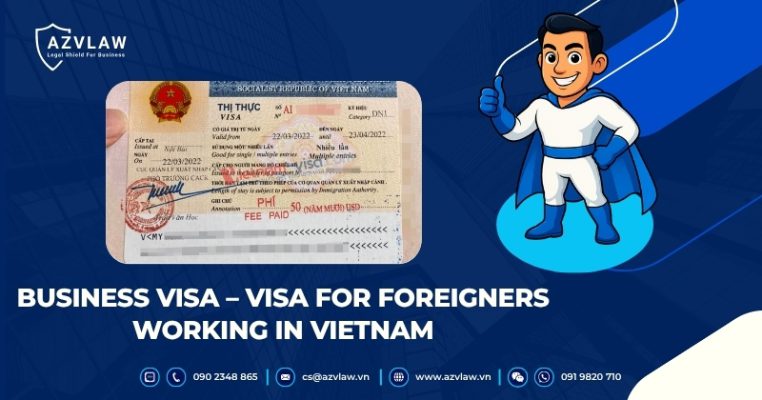
1. Navigating Vietnam’s Business Visa and Work Permit Landscape: Your Essential Guide
Entering a new market like Vietnam offers immense opportunities, but it also comes with its share of administrative complexities. From our vantage point at AZVLAW, we understand that Vietnam’s immigration, visa, and work permit procedures can often feel like a labyrinth, especially for foreign nationals planning a long-term stay or business operations in Ho Chi Minh City. This guide aims to clarify these processes, helping you navigate the legal requirements with confidence and peace of mind.
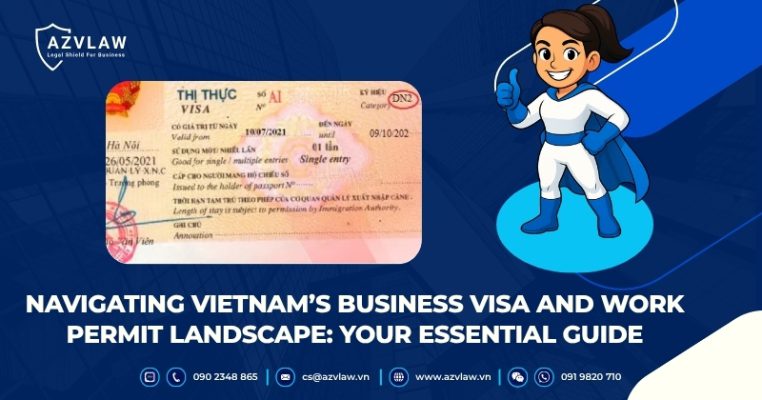
2. Initial Entry: Understanding Vietnam’s Visa Landscape
To begin your journey in Vietnam, a visa, typically issued by a Vietnamese Embassy or Consulate abroad, is often the first step. While this can be obtained in a third country, certain individuals may even secure a visa from within Vietnam under specific circumstances.
It’s important to note that Vietnam extends visa exemptions for various nationalities, allowing short, free-entry stays:
- ASEAN countries: Permitted stays typically range from 14 to 30 days.
- Chile and Panama: Enjoy a generous 90-day visa-free entry.
- Belarus, Denmark, Finland, France, Germany, Italy, Japan, Norway, Russia, South Korea, Spain, Sweden, and the UK (British citizens only): Granted 45 days of visa-free entry. Notably, the previous requirement for a 30-day gap between visa-free entries has been removed by recent immigration law updates.
For a broader range of nationalities, Vietnam’s new e-visa application system offers a convenient single-entry visa valid for up to 90 days. While the stated processing time is three working days after registration and fee payment, we strongly advise submitting your application at least two weeks prior to your intended arrival to account for potential variations in processing times due to application volume.
3. Beyond Tourism: Key Visa Categories for Long-Term Stays
For foreign nationals intending to work or establish a long-term presence in Vietnam, a standard tourist visa is often insufficient. Longer-term visas, such as three-month single or multiple-entry options, become necessary.
For those entering on business visas, it’s crucial to understand that these must typically be collected at a Vietnamese embassy or consulate and require sponsorship from a Vietnamese entity or your employer.
Here’s an overview of the relevant visa types for various purposes:
| Visa Type | Description | Validity |
| DL | Tourist visa | 90 days |
| HN | For attending meetings or conferences | 90 days |
| LD1 | For working in Vietnam, eligible for a work permit exemption. | 2 years |
| LD2 | For working in Vietnam, requiring a valid work permit. | 2 years |
| LV1 | For working with Central Party Committee agencies, provincial/city Party Committees, People’s Councils, People’s Committees, Government, National Assembly, Fatherland Front, Supreme People’s Court/Procuracy, State Audit, ministries, and government-affiliated agencies. | 1 year |
| LV2 | For working with social organizations, socio-political organizations, and the Vietnam Chamber of Commerce and Industry. | 1 year |
| LS | For foreign lawyers practicing in Vietnam. | 5 years |
| DT1 | Investor Visa: For investors with total investment capital exceeding VND 100 billion (approx. US$3.94 million), or investing in government-prioritized sectors, professions, or geographical areas. | 5 years |
| DT2 | Investor Visa: For investors with total investment capital between VND 50 billion (approx. US1.97million)andVND100billion(approx.US3.94 million), or investing in government-encouraged sectors, professions, or geographical areas. | 5 years |
| DT3 | Investor Visa: For investors with total investment capital between VND 3 billion (approx. US118,096)andVND50billion(approx.US1.97 million). | 3 years |
| DT4 | Investor Visa: For investors with total investment capital less than VND 3 billion (approx. US$118,096). | 1 year |
| DN1 | For working with entities possessing legal status in Vietnam. | 1 year |
| DN2 | For entering Vietnam to promote services, establish commercial presences, or conduct activities under Vietnam’s international agreements. | 1 year |
| EV | Electronic visa | 90 days |
| NN1-2 | For Chief Representatives of foreign Representative Offices in Vietnam or Heads of Project Offices of foreign NGOs. | 1 year |
| NN3 | For staff of foreign NGOs or Representative Offices. | 1 year |
| DH | For students or interns. | 1 year |
| NG1-4 | Diplomatic visa. | 1 year |
| PV1-2 | For press and foreign correspondents. | 1 year |
| TT | For dependents of holders of LV1-2, LS, DT1-3, NN1-2, DH, PV1, LD1-2 visas; or foreign parents, spouses, or children of Vietnamese citizens. | 1 year |
| VR | For expatriates visiting relatives or for other specified purposes. | 180 days |
| SQ | For market survey, tourism, visiting relatives, or medical treatment, specifically for individuals doing business with an overseas Vietnamese visa-issuing authority, their spouse and children; those with a written request by a competent Ministry of Foreign Affairs agency of the host country; or those with a diplomatic note of sponsorship by a foreign diplomatic or consular mission. | 30 days |
Note: Holders of LV1, LV2, LS, DT1, DT2, DT3, NN1, NN2, DH, PV1, LD1, LD2, and TT visas may be eligible to apply for a temporary residence card valid for 2 to 10 years, depending on the specific visa type.
4. Navigating the Nuances: Beyond the Basic Visa Application
From our experience, one of the most significant advancements in Vietnam’s immigration framework is the current flexibility allowing the conversion of one visa type to another without requiring the applicant to leave Vietnam. This provision can be a game-changer for individuals whose purpose of stay evolves after their initial entry.
However, this conversion is not universally applicable. You may be eligible to change your visa type if you entered Vietnam under one of the following categories and meet specific criteria:
- You are an investor or a representative of a foreign organization investing in Vietnam.
- You are a dependent (spouse, parent, or child) of a Vietnamese citizen.
- You have been invited or guaranteed by a Vietnamese agency or organization and possess a valid work permit or a certificate of work permit exemption.
Upon a successful visa conversion application, a new visa will be granted reflecting your updated purpose of stay. This flexibility, while beneficial, underscores the importance of understanding the precise conditions to avoid missteps.
5. Establishing Your Presence: The Work Permit Imperative
For any foreign national seeking to work legally in Vietnam, securing a work permit is a fundamental requirement, unless specifically exempted. Vietnamese entities are permitted to recruit foreign workers as managers, executive directors, and experts when local talent cannot yet fulfill business needs. Even Vietnamese representative offices are authorized to hire staff directly.
The process for obtaining a work permit in Vietnam involves several sequential steps, and proactive planning is crucial as the total timeline typically spans 1.5 to 2 months:
- Announcing Job Vacancy: Employers must announce the recruitment of Vietnamese workers for positions intended for foreign hires on either the Ministry of Home Affairs (Employment Department) website or a local Employment Service Center website. This must be done at least 15 days before submitting the explanation report.
- Explanation Reporting: An explanation report detailing the need for foreign workers must be submitted to the competent authority at least 15 days prior to the foreign worker’s start date. The authority then has 10 working days to issue a document specifying acceptable job positions for foreign workers.
- Applying for a Work Permit: The full work permit application must be submitted to the competent authority at least 15 working days before the foreign worker’s intended start date. If the application is complete, the work permit is usually issued within 5 working days.
A work permit is a prerequisite for applying for either a temporary residence card or a long-term working visa. Under the Labor Code 2019, which came into effect in 2021, work permits are issued for a maximum period of two years and are generally restricted to only one renewal for up to two additional years. After this, if continued employment is desired, the employer must go through the entire process of obtaining a new work permit.
Eligibility Requirements for Work Permits:
To be granted a work permit, applicants must meet specific conditions:
- Be at least 18 years of age and possess full legal capacity.
- Hold qualifications, occupational skills, and practical experience, along with adequate health, as prescribed by the Ministry of Health.
- Be classified as a manager, executive director, or expert with the necessary technical skills and knowledge for the job.
- Not be serving a sentence, have an unspent conviction, or be undergoing criminal prosecution under their home country’s laws or Vietnamese law.
- Possess a valid visa granted by a competent Vietnamese authority, unless otherwise stipulated by law.
Additionally, specific criteria apply based on the job assignment:
- Expert:
- Holds at least a bachelor’s degree (or equivalent) and has a minimum of 3 years of experience relevant to the job position in Vietnam; OR
- Possesses at least 5 years of experience and a practice certificate corresponding to the job position in Vietnam.
- May also fall under special cases as determined by the Prime Minister based on a request from the Ministry of Labor, War Invalids and Social Affairs.
- Manager or Executive:
- Must be verifiable through the company’s charter or operational regulations, certificate of enterprise registration, establishment decision, or other equivalent legal documents.
- Requires a resolution or appointment decision from the relevant agency, organization, or enterprise.
- Technical Worker:
- Has received at least 1 year of training and possesses at least 3 years of experience corresponding to the job position in Vietnam; OR
- Possesses at least 5 years of experience corresponding to the job position in Vietnam.
Key Documents for a Work Permit Application:
A comprehensive application dossier is essential and typically includes:
- Application form.
- Health certificate (issued within the past year per Ministry of Health guidelines).
- Police or criminal clearance certificate (no less than six months old).
- Proof of qualification as a manager, executive, expert, or technical worker (e.g., diplomas, experience letters, practice certificates).
- Acceptance document from the Department of Home Affairs confirming the demand for foreign employees.
6. Protecting Your Presence: Why Compliance is Non-Negotiable
Ignoring Vietnam’s immigration and labor laws can lead to significant penalties for both foreign workers and their employers. Compliance is not merely a formality; it’s a critical safeguard for your legal standing and business operations.

Work Permit Termination:
A work permit may be terminated under various circumstances, including:
- Expiration of the work permit.
- Termination of the labor contract.
- Inconsistency between the labor contract’s content and the granted work permit.
- The foreign employee is being fired by the foreign employer.
- Withdrawal of the work permit by authorized state agencies.
- Termination of the operation of the company, organization, or partners in Vietnam.
- The work performed does not conform to the granted work permit.
- The employer hiring the foreign employee ceases its operation.
Penalties for Non-Compliance:
Foreign workers operating without a valid work permit or work permit exemption certificate, or using expired documents, face fines ranging from VND 15 million to VND 25 million (approx. US588–US980) and may be deported.
Employers who hire foreign workers without the necessary permits or exemption certificates face even steeper fines, ranging from VND 30 million to VND 75 million (approx. US1,000–US3,000). To mitigate these risks, a notice must be submitted 5 days in advance to the provincial Department of Home Affairs prior to a foreign worker commencing work in Vietnam.
Work Permit Exemptions:
While a work permit is generally required, certain situations exempt foreigners from needing one, though a work permit exemption certificate may still be required. This certificate is equivalent to a work permit, valid for up to 2 years, and also serves as a basis for applying for a temporary residence card.
Common exemptions include:
- Working for a period of less than 30 days and up to 3 times a year as a manager, executive, expert, or technical worker.
- Being a member of a limited liability company with two or more members, with a capital contribution of at least VND 3 billion (approx. US$127,000).
- Being the owner of a single-member limited liability company with a capital contribution of at least VND 3 billion (approx. US$127,000).
- Being a member of the board of a joint-stock company with a capital contribution of at least VND 3 billion (approx. US$127,000).
- Entering Vietnam for less than 3 months to market products and services.
- Entering Vietnam for less than 3 months to resolve an emergency or technologically complex situation affecting production that cannot be resolved by local or existing foreign experts.
- Lawyers granted a professional practice permit in Vietnam.
- Heads of representative offices, chiefs of project offices, or those working for foreign non-government organizations in Vietnam.
- Individuals internally transferred within an enterprise that has a commercial presence in Vietnam under World Trade Organization committed service lists (e.g., business services, information, construction, distribution, education, environment, financial, health, tourism, cultural/recreational, and transportation services).
- Providing consulting services for ODA programs and projects in accordance with international treaties.
- Marriage to a Vietnamese citizen.
- Possessing a communication and journalism practice certification in Vietnam issued by the Ministry of Foreign Affairs.
- Other circumstances specified by the Government.
7. Securing Long-Term Stay: Temporary and Permanent Residence Cards
For foreign nationals planning an extended stay in Vietnam, beyond what a standard visa provides, Temporary Residence Cards (TRCs) and Permanent Residence Cards (PRCs) offer more stable, long-term legal status.
Temporary Residence Cards (TRCs):
A TRC is a highly sought-after document issued by the immigration agency under the Ministry of Public Security. It essentially acts as a long-term visa, allowing foreign employees and other eligible individuals to reside in Vietnam without needing multiple visa extensions or re-entry visas within its validity period.
- Eligibility: Foreigners holding work permits valid for one year or more, work visas, members of management boards of directors, heads of company branches, and Chief Representatives of foreign representative offices are typically eligible.
- Validity: TRCs can be valid from one to ten years, with the duration tied to the visa type and the amount of contributed capital for investors:
- TRC – DT1 (major investor): Up to 10 years
- TRC – NG3, LV1-2, LS, DT2, DH: Up to 5 years
- TRC – NN1-2, DT3, TT: Up to 3 years
- TRC – LD1-2, PV1: Up to 2 years
- Note: Investors with a DT4 visa (capital investment less than VND 3 billion) are not eligible for a TRC.
- Key Condition: The validity of a TRC must be at least 30 days shorter than the remaining validity of your passport.
- Benefits: Allows entry and exit from Vietnam without a visa during its validity. Expired TRCs may be considered for renewal.
- Processing Time & Fee: Typically takes five working days. Fees generally range from VND 3.6 million to VND 4.1 million (approx. US145–US165) depending on the card’s duration.
Permanent Residence Cards (PRCs):
The Permanent Residence Card offers the most stable long-term status for expatriates in Vietnam. This card signifies legal residence and the ability to earn a living indefinitely.
- Eligibility: PRCs are granted under more stringent conditions, primarily to individuals who:
- Have significantly contributed to Vietnam’s development and have been awarded a medal or title by the government.
- Have resided temporarily in Vietnam for three or more consecutive years and are sponsored by a Vietnamese parent, spouse, or child who holds permanent residence in Vietnam.
- Are foreign scientists or experts recommended by the head of a ministerial or government agency.
- Benefits: A PRC holder can stay in Vietnam indefinitely without requiring a visa for entry or exit.
- Re-issuance: The card must be re-issued every 10 years.
- Processing Time & Fee: Processing typically takes five working days, with a fee ranging from VND 3.6 million to VND 4.1 million (approx. US145–US165).
AZVLAW’s Vietnam business visa for foreigners always focuses on client satisfaction. We understand the difficulties and worries clients may face during the visa application process, so we commit to providing fast, effective, and reliable service. When choosing AZVLAW, clients will feel absolutely secure about the quality of service. If you want to save time and effort, do not hesitate to contact us immediately via HOTLINE: 090 2348 865 for the fastest and most accurate visa consultation and support!