Trụ Sở


How to Successfully File a declaration of inheritance: Step-by-Step Process
Home Legal services Declaration of inheritance
In moments of grief, the last thing anyone wants to face is intricate legal procedures. Yet, to properly manage a loved one’s legacy in Vietnam, the declaration of inheritance is a necessary and often complex step. Whether you are an heir, an executor, or simply seeking clarity on your rights and obligations in Ho Chi Minh City, understanding this process is vital. At AZVLAW, we offer compassionate and expert legal counsel, transforming legal challenges into clear, manageable pathways, ensuring your inheritance matters are handled with dignity and precision.
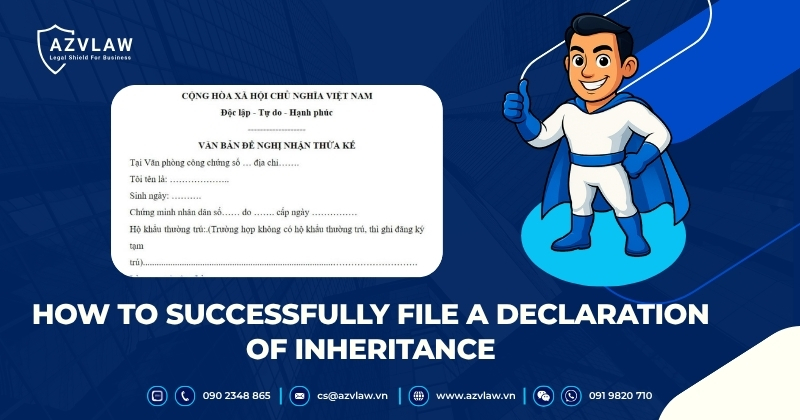
1. Order and Procedure for Declaring Inheritance in Vietnam
The process of declaring and distributing an inheritance in Vietnam involves specific steps, primarily conducted through notary offices. This ensures the legal validity of the inheritance transfer and protects the rights of all heirs.
a. Commencement of Inheritance: Inheritance commences at the time of the deceased person’s death. This is the moment when their property officially becomes an estate to be distributed.
b. Key Steps for Declaring Inheritance (typically for real estate or significant assets):
- Gathering Required Documents: This is the crucial first step. You will need:
- Death Certificate of the deceased.
- Documents proving the relationship between the deceased and the heirs (e.g., birth certificates, marriage certificates, household registration books, adoption certificates).
- Original ownership documents of the estate (e.g., Red Book/Pink Book for land/house, vehicle registration papers, bank statements, share certificates).
- Identity papers of the heirs (ID cards/passports).
- The Will (if one exists).
- A written request for an inheritance declaration/acceptance or an agreement on inheritance division.
- Submission to a Notary Office: The dossier is submitted to a notary office, usually in the locality where the deceased resided or where the primary asset (e.g., real estate) is located.
- Notary Office Review and Public Posting:
- The notary public will review the submitted dossier for completeness and validity.
- If the dossier is in order, the notary’s office will post a public notice at the commune-level People’s Committee where the deceased last resided (or where the property is located if residency is unclear). This posting serves to inform potential heirs or creditors and allows a 15-day period for any complaints or denunciations regarding the inheritance.
- Notarization of Inheritance Documents:
- After the 15-day posting period, if no complaints or disputes arise, the notary’s office will proceed to notarize the written declaration of inheritance acceptance or the written agreement on inheritance division among the heirs.
- All heirs (or their authorized representatives) must sign these documents in the presence of the notary.
- Fulfillment of Financial Obligations:
- Heirs are typically required to pay personal income tax (PIT) on the inherited assets, if applicable (with certain exemptions for close relatives like spouses, parents, children, etc.).
- Other fees, such as registration fees for property ownership transfer, may also apply.
- Registration of Property Rights (for real estate, vehicles, etc.):
- After notarization and tax payment, the heirs must complete the procedures to register the ownership transfer at the relevant state agencies (e.g., Land Registration Office for land/house, traffic police for vehicles). This results in a new ownership certificate being issued in the heirs’ names.
- It’s important to note that heirs must register this change within 30 days of the inheritance distribution, or administrative penalties may apply.
2. What is the Division of Inheritance for the First Level of Heirs in Vietnam?
In Vietnam, inheritance can be divided either according to a valid will (testamentary inheritance) or by law (intestate inheritance) if no will exists, the will is invalid, or it only covers part of the estate. When inheritance is distributed by law, a strict order of priority is followed.
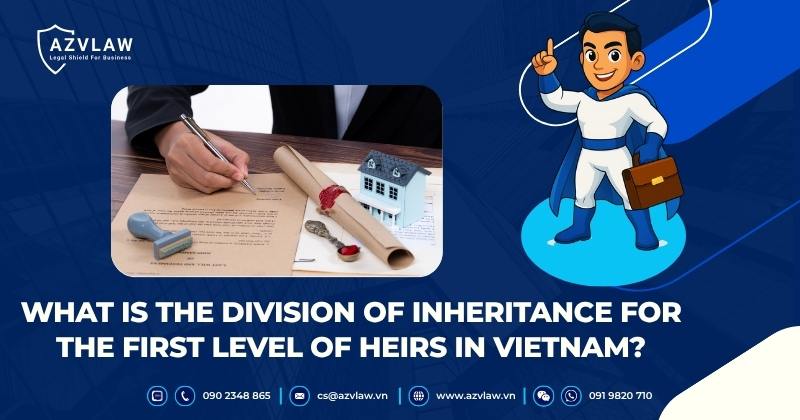
The Civil Code 2015 (Article 651) clearly defines three levels of heirs. The first level of heirs is the highest priority and includes:
- Spouse: The surviving legal spouse of the deceased.
- Biological Parents: Both the biological mother and father of the deceased.
- Adoptive Parents: Legally recognized adoptive parents of the deceased.
- Biological Children: All biological children of the deceased.
- Adopted Children: Legally recognized adopted children of the deceased.
Key Principles for First-Level Heirs:
- Equal Shares: All individuals within the first level of heirs are generally entitled to equal shares of the estate, unless otherwise agreed upon or if certain heirs are disinherited (under very specific legal conditions) or renounce their inheritance.
- Priority: Heirs in a subsequent level (second or third) only inherit if there are no heirs in the preceding level due to death, disqualification, disinheritance, or renunciation of the inheritance.
- Right of Succession (Thừa kế thế vị): If a child or adopted child of the deceased dies before or at the same time as the deceased, their direct descendants (grandchildren of the deceased) will inherit the portion that their parent would have received had they been alive. This rule applies only to inheritance by law, not by will.
For example, if a deceased person leaves behind a spouse, two biological children, and an adoptive parent, all four individuals would typically receive an equal share of the estate if there is no will.
3. Will Inheritance in the Will Be Changed if There Is a Change in Vietnam?
Yes, inheritance stipulated in a will can be subject to changes in Vietnam, both due to actions by the testator and certain legal provisions. A will, while reflecting the testator’s wishes, is not entirely immune to external factors.
a. Changes Initiated by the Testator:
- Amendment, Supplementation, Replacement, or Revocation: Under Vietnamese law, a testator has the right to amend, add to, replace, or completely revoke their will at any time while they are of sound mind and not under duress.
- Amendment/Supplementation: If a testator adds to an existing will (e.g., via a codicil), the original will and the new addition are generally considered equally valid, as long as they don’t contradict each other.
- Replacement: If a testator creates a new will explicitly replacing an old one, the new will becomes effective, and the previous one is revoked.
- Revocation: A testator can simply revoke their will, rendering it invalid.
- Most Recent Will Prevails: If a testator leaves behind multiple wills regarding the same property, only the most recent legally valid will shall be effective.
b. Changes Imposed by Law (Forced Heirship):
Even with a valid will, Vietnamese law includes provisions for “forced heirs” (thừa kế không phụ thuộc vào nội dung di chúc) who are entitled to a portion of the estate regardless of the will’s contents. This is a crucial aspect of Vietnamese inheritance law, often surprising to those from common law jurisdictions.
According to Article 644 of the 2015 Civil Code, the following persons, if not provided for in the will or if given a share less than what they would receive by law, are still entitled to a portion of the estate:
- Minor Children of the Testator: Children who are under 18 years old.
- Father, Mother, or Spouse of the Testator.
- Adult Children of the Testator who are Incapable of Working: This typically refers to children over 18 who have severe disabilities or illnesses preventing them from working.
The share these forced heirs are entitled to is two-thirds (2/3) of the share they would have received if the estate had been divided by law (i.e., if there was no will). This means even if a will explicitly excludes one of these individuals, the law mandates that they receive this minimum portion. The remainder of the estate is then distributed according to the will’s provisions.
c. Changes Due to Illegality or Invalidity:
A will can be changed or deemed ineffective if:
- Invalidity: The will does not meet legal requirements (e.g., testator was not of sound mind, not properly witnessed, not notarized when required, forged).
- Illegal Content: The will’s contents violate the prohibitory provisions of the law or social ethics.
- Heir Disqualification: An heir named in the will is legally disqualified from inheriting (e.g., convicted of intentionally causing the death of the testator).
Therefore, while a will is a powerful tool for expressing one’s wishes, its final implementation in Vietnam is subject to both the testator’s subsequent actions and specific legal safeguards designed to protect certain vulnerable family members.
For a confidential consultation regarding your declaration of inheritance or any other inheritance-related matter in Ho Chi Minh City or anywhere in Vietnam, please do not hesitate to contact AZVLAW today via HOTLINE: 090.2348.865. We are here to provide the compassionate, expert guidance you need.