Trụ Sở


Securing Your Legacy: AZVLAW’s Comprehensive Home-Based Will Drafting Service in Vietnam
Home Legal services Will drafting services
Planning for the future, especially when it involves the distribution of your assets and the care of your loved ones, is one of the most significant responsibilities you undertake. For both Vietnamese citizens and foreign nationals with assets in Vietnam, having a legally sound will is crucial to ensure your final wishes are honored and to provide peace of mind for your family. Navigating the intricacies of Vietnamese inheritance law and drafting a document that is both comprehensive and legally enforceable requires expert knowledge. At AZVLAW, our specialized will drafting services are designed to provide clear, secure, and personalized solutions, safeguarding your legacy for generations to come.

1. Why Is Drafting a Will So Crucial for You?
In a world full of uncertainties, drafting a will is one of the most responsible and empowering decisions you can make. It’s not just about distributing wealth—it’s about protecting your loved ones, preserving harmony, and making sure your final wishes are respected.
Whether you have significant assets or modest savings, having a legally recognized will ensures that what you’ve built in your lifetime is handled exactly the way you intend. So, why is drafting a will so crucial for you? Let’s explore the key reasons.
Drafting a will is not just a legal formality; it’s a profoundly meaningful act that brings peace of mind and safeguards family harmony for generations to come. Here are the compelling reasons why you should seriously consider preparing your will today:
Minimizing Family Disputes: This is, without a doubt, the paramount benefit of a valid will. When your assets are clearly and specifically divided according to your precise wishes, the potential for conflicts, disagreements, or even costly lawsuits among family members – particularly between children or siblings – is dramatically reduced. This foresight helps preserve the unity and tranquility of your family long after you’re gone.
Ensuring Your Personal Wishes Are Honored: A will is the only legal instrument that grants you the complete freedom to dispose of your assets exactly as you intend. You can allocate specific portions of your estate for purposes like ancestral worship, charitable contributions, caring for individuals who have dedicated themselves to you, or any other specific objectives permitted by law. Without a will, your assets would be distributed strictly according to statutory inheritance laws, which may not align with your true desires.
Freedom to Designate Beneficiaries Beyond Legal Heirs: One of the most powerful rights afforded to a will-maker is the ability to transfer your legacy to anyone you wish – not just those designated as legal heirs under Vietnamese law. This provides maximum flexibility in asset distribution, allowing you to include individuals who may not be related by blood or marriage but who have played a significant role in your life or contributed to your well-being.
Flexibility to Modify or Revoke Your Will: Unlike other asset transactions (which are often difficult to reverse once completed), a will can be modified, supplemented, or even completely revoked at any time. This flexibility is contingent only upon your continued mental capacity and lucidity. This ensures your will always accurately reflects your current wishes and life circumstances, providing an adaptable solution as your life evolves.
In essence, creating a will is not just an optimal solution for preventing family disputes; it’s also the most effective way to protect your rights and wishes as the asset owner, ensuring your estate is distributed legally, transparently, and meaningfully.
2. Contents and Regulations: What Makes a Will Valid?
When drafting your will, the most critical aspect is ensuring that it strictly adheres to current legal regulations. This is paramount to guarantee its legal validity and prevent it from being challenged or deemed void in the future.
According to Article 631 of the 2015 Civil Code of Vietnam, a valid will must include the following essential information:
- Date, Month, Year of Will Creation: This information is crucial for determining which will is valid in cases where multiple wills exist.
- Full Name and Address of the Will-Maker: Essential for clearly identifying the individual whose assets are being bequeathed.
- Full Names of Individuals, Agencies, or Organizations Designated as Heirs: These must be clearly and specifically stated to avoid any ambiguity.
- Detailed List and Address of Inherited Assets: A precise inventory of the assets (e.g., land plot number, map sheet, house address, bank savings account number, securities details, etc.) that you wish to distribute.
- Other Necessary Information: Any additional clauses, conditions, or specific wishes the will-maker desires to include, provided they do not contravene the law.
Crucial Legal Caveats:
- The content within your will must not violate any prohibitions stipulated by law or societal ethics.
- The will-maker only has the right to dispose of assets legally owned by themselves. If a will includes assets not legally recognized as yours, or assets not owned by you at the time of your passing, the portion of the will pertaining to those assets may be deemed void.
- If the asset in question is land for which a Red Book (Certificate of Land Use Rights) has not yet been issued, or if it’s a joint asset of a married couple or household, the will’s content must be meticulously drafted to align precisely with the will-maker’s legitimate rights of disposal.
3. Common Forms of Wills Recognized by Vietnamese Law
In Vietnam, creating a valid will is a crucial step in securing your assets and ensuring your final wishes are honored. Under Vietnamese law, several types of wills are legally recognized, each with specific conditions for validity.
From written wills to oral declarations in urgent situations, understanding these forms is essential for anyone looking to plan their estate with confidence and clarity
Vietnamese law recognizes several forms of wills, each with specific requirements for validity:
a. Oral Wills (Di Chúc Miệng)
Oral wills are strictly reserved for urgent circumstances where the will-maker faces an immediate threat to life and cannot possibly create a written will. For an oral will to be legally valid:
- The will-maker must clearly state their wishes in front of at least two witnesses.
- Immediately thereafter, these wishes must be transcribed into a written document, bearing the signatures or fingerprints of the witnesses.
- This written record of the oral will must be notarized or certified within 5 working days from the date the will-maker expressed their wishes.
Limited Validity: Critically, an oral will automatically becomes void if, after three months from the date the wishes were expressed, the will-maker is still alive and fully mentally capable of understanding and making decisions regarding their assets.
b. Written Wills (Handwritten or Typed)
Written wills are the most common and generally the most secure form. They can be either handwritten entirely by the will-maker or typed. To ensure legal effectiveness, a written will must contain all the required information mentioned above, and its content must be clear and precise to prevent any future disputes.
Written wills can be executed in several ways:
- Without Witnesses: The will-maker personally writes and signs the will. In this case, the will-maker must be fully lucid, mentally capable, and not under any physical or mental duress.
- With Witnesses: This form is used when the will-maker cannot personally write or sign, or cannot visit a notary office. It requires at least two witnesses who are not beneficiaries or have any direct interest in the estate.
- Notarized or Certified Wills: This is the strongest and most legally secure form. It is authenticated by a notary public (at a Notary Office) or a judicial officer (at the Commune/Ward People’s Committee). This process provides a strong presumption of validity and greatly reduces the likelihood of future challenges.
- For handwritten wills: The entire content must be handwritten and signed by the will-maker themselves.
- For typed wills: The will must bear the signature or fingerprint of the will-maker. If it spans multiple pages, each page must be numbered and bear the will-maker’s signature or fingerprint. Any corrections or erasures must be initiated or signed by the will-maker next to the alteration.
4. Will Drafting Procedures and Validity Conditions
Drafting a will involves more than simply articulating your wishes; it demands strict adherence to legal conditions and procedures to ensure its absolute validity when it matters most.
4.1. Requirements for the Will-Maker
For a will to be legally effective, the will-maker must meet specific conditions at the time of its creation:
Legal Age: The individual must be 18 years of age or older. Crucially, the will-maker must be fully mentally capable and lucid, free from deception, threats, or coercion throughout the entire process of drafting and signing the will.
Minors (15 to under 18 years old): Can create a will, but it must be in writing and have the consent of their parents or legal guardian.
Individuals with Physical Limitations or Illiteracy: Wills made by such individuals must be in written form, include witnesses, and be notarized or certified as per regulations.
4.2. Rights of the Will-Maker
Once you are legally eligible to create a will, you have full authority to determine the disposition of your estate, including:
- Designating Heirs: You are free to choose any individual or organization as an heir to your estate.
- Disinheriting Heirs: You have the right to disinherit one or more legal heirs without needing to provide a reason.
- Asset Division: You can precisely dictate how and in what proportions your assets are to be divided among specific heirs.
- Specific Allocations: You can set aside a portion of your estate for purposes such as ancestral worship, charitable activities, or humanitarian causes.
- Assigning Obligations: You can impose specific obligations on your heirs (e.g., caring for a relative, completing a particular task).
- Appointing Administrators: You can designate an executor for your estate, a custodian for your will, and an individual responsible for overseeing asset distribution.
4.3. Conditions Regarding the Inherited Assets
Existence at the Time of Death: The assets specified in the will must still exist and legally belong to the will-maker at the time of their passing. If only a portion of the assets remains, the part of the will pertaining to the existing assets will still be valid.
4.4. Conditions Regarding the Heirs
Existence at the Time of Death: The organizations or individuals designated as heirs must be alive (for individuals) or still legally operating (for organizations) at the time of the will-maker’s death. If an heir predeceases or passes away concurrently with the will-maker, the will’s provisions pertaining to that heir’s inheritance will cease to be effective.
4.5. Required Dossier and Competent Authorities for Will Certification
To establish a legally valid will, you’ll generally need to prepare the following essential documents:
Valid Personal Identification: Your Citizen Identity Card (CCCD), valid passport, or other legitimate legal identification.
Household Registration Book (Hộ khẩu) or Proof of Permanent Residence: To confirm your registered address.
Original Documents Proving Asset Ownership: This is crucial. Examples include Certificates of Land Use Rights, Certificates of House Ownership, bank savings passbooks, vehicle registration papers, securities certificates, etc., for all assets you wish to bequeath.
Documents Proving Joint or Separate Property: If assets are joint property with a spouse (e.g., marriage certificate) or part of a household’s joint property, supporting documentation as per the Law on Marriage and Family is needed.
Health Certificate: Issued by a hospital or medical center at the district level or higher, confirming that the will-maker is fully lucid, mentally capable, and possesses full civil act capacity at the time of will creation.
Competent Authorities for Will Certification: The certification of a will falls under the jurisdiction of a notary public office (either a Public Notary Office or a Private Notary Office) or the People’s Committee at the commune/ward/township level. These are the official bodies authorized to verify and confirm the legality of your will.
4.6. Validity of a Will
A will becomes effective from the time of succession opening (the moment the will-maker passes away). However, a will can be rendered wholly or partially invalid in certain circumstances, including:
- The designated heir predeceases or passes away concurrently with the will-maker.
- The designated inheriting organizations no longer exist at the time of succession opening.
- The inherited assets specified in the will no longer exist or have been significantly reduced at the time of succession opening. In this scenario, only the portion of the will relating to the non-existent or reduced assets will be invalid.
- If only a part of the will is deemed illegal but does not affect the remaining provisions, only that illegal part will be invalidated.
- In cases where an individual leaves multiple wills concerning the same assets, the latest valid will shall take effect.
Adhering to these conditions rigorously ensures the legality and effectiveness of your will, protecting the rights of both the will-maker and the beneficiaries, thereby preventing avoidable disputes over assets.
5. AZVLAW’s Comprehensive Home-Based Will Drafting Services: Quick and Reliable Solutions
At AZVLAW, we don’t just provide legal services; we deliver peace of mind and a complete solution for the disposition of your assets. With our deep expertise in inheritance law and a team of seasoned, compassionate lawyers, we confidently stand as your trusted choice for comprehensive, home-based will drafting services.
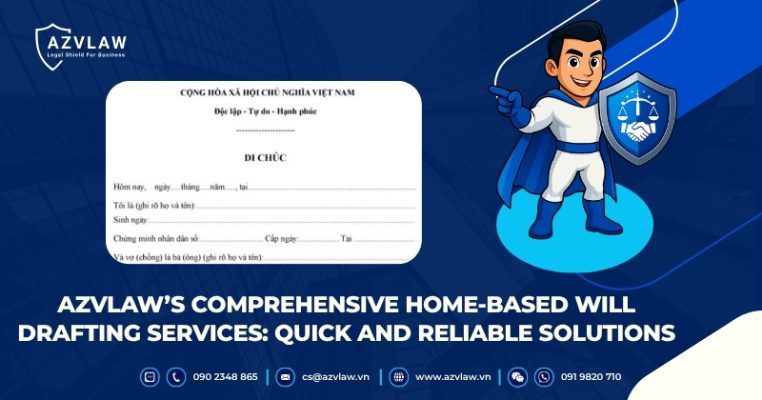
5.1. Our Specialized Will Drafting Services at AZVLAW:
AZVLAW offers in-depth and practical legal consultation services in the field of inheritance and wills, including:
- Personalized Consultation & Will Drafting: We meticulously listen to your wishes, provide expert legal advice on relevant regulations, and meticulously draft your will. We ensure it’s detailed, precise, and accurately reflects your intentions while being fully compliant with the law. We provide both typed and handwritten will templates that adhere strictly to legal standards.
- Will Drafting for All Asset Types: Whether your assets include real estate, bank savings, stocks, or even assets without a “Red Book” (but for which you possess legal ownership documents), our experienced team is adept at drafting a suitable will for your specific circumstances.
Support for Diverse, Secure Will Formats: We assist you in choosing and drafting your will in any legally recognized format:
- Oral Wills (in urgent situations): We guide you through the process and ensure timely notarization/certification to uphold their legal validity.
- Witnessed Wills at Home: We can help identify, invite, and ensure the legal eligibility of witnesses, and facilitate the drafting and signing process right in the comfort of your home.
- Notarized/Certified Wills at Home: This is a particularly convenient option. A notary public or judicial officer can come directly to your residence to notarize a pre-drafted will or assist you in declaring your wishes on-site. Please note that additional fees may apply for services outside regular office hours or at an off-site location.
- Will Appraisal & Validation: We offer services to review, verify, and confirm the legal validity of wills you may have created previously, providing you with reassurance about their enforceability.
- Will Storage & Public Disclosure: We provide secure storage services for your will and assist with its public disclosure when necessary, according to your instructions.
- Support for Inheritance Declaration: After the will is effective, we assist with the procedures for declaring the inherited estate, whether based on the will or statutory law, ensuring a smooth and efficient process for your heirs.
- Inheritance Dispute Resolution: In the unfortunate event of conflicts, AZVLAW has a team of experienced litigation lawyers ready to defend your legitimate rights in disputes related to wills and inheritance.
5.2. AZVLAW’s Home-Based Will Drafting Process: Simple and Efficient
To ensure our clients can create their wills accurately, legally, and with utmost convenience, AZVLAW provides a streamlined and effective 5-step process:
Step 1: Initial Consultation: You can contact us immediately for a free initial consultation with our professional legal team. We’ll listen carefully to your wishes and help you choose the most suitable will drafting approach.
Step 2: Service Registration & Will Format Selection: After the consultation, you’ll register for our will-drafting service and decide on your preferred will format (e.g., handwritten, witnessed, notarized/certified).
Step 3: Fee Deposit & Information Provision: You’ll confirm the service fee deposit and provide all necessary personal information and asset details to enable our lawyers to meticulously draft your will.
Step 4: Draft Will Review: Our lawyers will draft the will and send a draft to you for review. You’ll carefully examine the content and request any necessary revisions, ensuring every detail precisely reflects your intentions.
Step 5: Signing & Will Storage: Once all content is finalized and you are completely satisfied, the will will be formally signed by legal regulations. AZVLAW will assist with notarization/certification procedures (if chosen) and securely store your will as per your request, ensuring its legal validity and absolute confidentiality.
5.3. Why Choose AZVLAW for Your Will Drafting Needs?
Selecting AZVLAW for your will-drafting service means choosing peace of mind and superior efficiency:
- High Expertise & Experienced Legal Team: Our dedicated team of lawyers possesses extensive experience in inheritance and will drafting. We guarantee you receive accurate, effective advice and that your rights are maximally protected under Vietnamese law.
- Quick & Convenient Home-Based Service: AZVLAW prioritizes your convenience. Our home-based drafting service saves you valuable time and effort, eliminating the need for travel. It’s especially ideal for busy individuals or those with mobility limitations. All legal procedures are handled meticulously in the comfort of your own space.
- Comprehensive Legal Consultation: Our service extends beyond just drafting your will. We provide in-depth advice on inheritance rights, practical asset division strategies, property obligations, and proactive measures to protect your estate from potential future disputes.
- Flexible Will Solutions for Every Need: We understand that every individual has unique circumstances and wishes. Therefore, we offer various will formats – from self-written wills, witnessed wills, to notarized/certified wills at home – allowing you to choose the option that perfectly aligns with your situation and personal preferences.
- Absolute Confidentiality: AZVLAW is committed to absolute confidentiality regarding all your personal information and asset details. You can rest assured that your most private and important wishes will remain secure and executed exactly as desired, without external disclosure.
- Reasonable & Transparent Fees: We provide our will drafting services with clear, upfront, and reasonable fees, free from any hidden costs. You will always know the precise cost before committing to our service.
- Support in Resolving Inheritance Disputes: In the unfortunate event that a dispute arises concerning your will or inheritance, AZVLAW’s experienced litigation lawyers are ready to assist you in resolving the matter swiftly and effectively, safeguarding your legitimate rights under the law.
Choosing AZVLAW is choosing safety and reliability to protect your assets and ensure your final wishes are executed precisely and correctly. Don’t hesitate to contact us today for accurate, legal will drafting that brings you and your family lasting peace of mind.
For a confidential consultation regarding your will drafting service needs, whether for asset protection, guardianship planning, or complex estate arrangements in Ho Chi Minh City or anywhere in Vietnam, do not hesitate to contact AZVLAW today via HOTLINE: 090.2348.865. We are here to help you secure your legacy and provide peace of mind for your loved ones with unwavering confidence.